


Organizations today operate in environments defined by constant change, new technologies, and shifting workforce expectations. To succeed, leaders must cultivate skills that strengthen relationships, guide teams through uncertainty, and encourage growth. While many are familiar with emotional intelligence (EQ), adaptability quotient (AQ) is lesser known but just as vital.
Together, EQ and AQ equip leaders with two distinct but mutually reinforcing capabilities: the interpersonal awareness needed to understand how people experience change, and the cognitive flexibility required to recalibrate plans, processes, and priorities in real time. When leaders pair these skills, they can anticipate and respond to disruption with greater precision, adjust workflows and expectations without eroding trust, and help teams shift from reactive problem-solving to proactive experimentation. This combination enables teams to maintain alignment during ambiguity and sustain performance even as external demands continue to evolve.
What Is Emotional Intelligence?
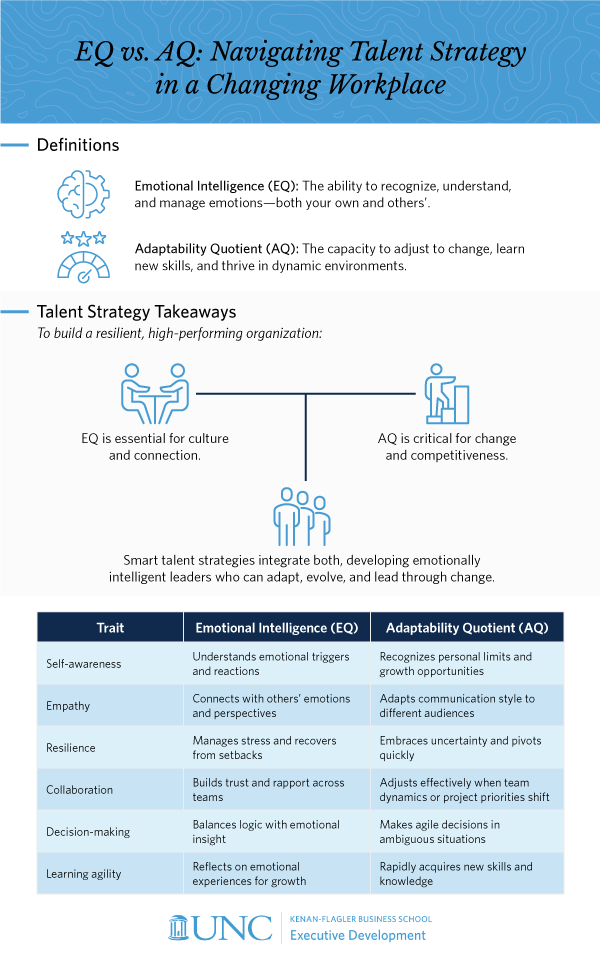
Emotional intelligence refers to an individual’s ability to recognize, understand, and manage their own emotions as well as those of others. Emotional intelligence combines self-awareness, self-regulation, social awareness, and relationship management into a set of skills that improve collaboration and leadership effectiveness.
EQ is increasingly being recognized by scholars and organizations as a better predictor of success than technical skills. In fact, 75% of people managers use emotional intelligence to gauge readiness for promotions and salary increases, and 57% say their highest performers have strong emotional intelligence.

Emotional Intelligence Applications
EQ plays a critical role in shaping an organization’s overall talent strategy. In talent development, it allows leaders to provide feedback in a way that motivates growth rather than discouragement, helping employees build confidence and improve performance. When it comes to collaboration, high-EQ individuals are better at navigating interpersonal differences, which reduces friction and creates more productive team dynamics.
The influence of emotional intelligence extends to leadership and organizational change as well. Executives with strong EQ establish cultures where engagement and resilience are prioritized, setting the tone for how people interact and respond to challenges. During times of transition, emotionally intelligent leaders can sense the morale of their teams and address concerns with empathy and clarity, ensuring smoother change management and stronger long-term outcomes.
What Is Adaptability Quotient?
Adaptability quotient reflects a person’s capacity to adjust to change, learn new skills, and thrive in evolving environments. While EQ focuses on emotional awareness and relationships, AQ emphasizes flexibility, resilience, and the ability to see opportunity in disruption. Individuals with high AQ embrace continuous learning, pivot strategies when needed, and remain calm in the face of ambiguity.
In a landscape shaped by rapid technological innovation, shifting workforce dynamics, and global uncertainty, AQ has emerged as an essential capability. For organizations, fostering adaptability helps create teams that are resilient, engaged, and ready to meet the demands of a constantly changing world.
Adaptability Quotient Applications
AQ is a key factor in organizational success that touches many areas of talent strategy and performance. In learning and development, individuals with strong AQ embrace reskilling and upskilling, adapting quickly to emerging tools and processes. This same adaptability strengthens crisis response, as high-AQ teams contribute to organizational resilience.
AQ also fuels innovation and long-term talent strategies. Professionals who demonstrate adaptability can adjust their strategies, test new ideas, and approach problems with flexible, creative thinking. By prioritizing AQ in hiring, organizations build workforces that can evolve with business needs, ensuring they remain agile and competitive in an environment defined by constant change.
Implementing EQ and AQ in Talent Management and Acquisition
Recognizing the importance of EQ and AQ is only the first step. To make these concepts actionable, organizations need to develop deliberate strategies for integrating them into their talent management practices. This requires moving beyond one-time workshops or surface-level assessments and instead creating systems that consistently value and reinforce these capabilities. Organizations seeking to integrate EQ and AQ into their talent strategy can:
- Integrate assessments into leadership development. Incorporate EQ and AQ evaluations into promotion pipelines, leadership program entry criteria, and ongoing coaching cycles. Use multi‑rater (360) instruments and scenario‑based assessments to identify how emerging leaders handle ambiguity, interpersonal tension, and rapid change. Tie assessment outcomes to individualized development plans with measurable progression milestones.
- Offer ongoing learning opportunities. Provide a structured curriculum that develops EQ and AQ over time through layered learning pathways. This can include executive education programs, peer coaching groups, practice labs that simulate high‑change environments, and curated stretch assignments. Reinforce learning with quarterly check‑ins that require leaders to demonstrate application of new capabilities in real organizational scenarios.
- Model at the top. Executive teams should adopt behaviors that signal EQ and AQ expectations, such as transparent decision‑making during uncertainty, active listening protocols in leadership meetings, and debriefs that unpack emotional and adaptive dynamics after major initiatives. Make EQ and AQ visible by incorporating these competencies into senior‑leader scorecards, communication norms, and recognition systems.
- Create a supportive culture. Codify EQ and AQ in organizational processes to make them part of the operating model. Embed these competencies into performance reviews, team operating principles, and leadership expectations at every level. Incorporate adaptability metrics, such as adoption timelines, change‑readiness indicators, and cross‑functional collaboration measures, into business dashboards. Recognize and reward teams that demonstrate strong adaptive behavior, reinforcing these capabilities as core to organizational identity.
Bringing EQ and AQ Together for Lasting Impact
As organizations prepare for the future of work, both emotional intelligence and adaptability quotient will play central roles in shaping resilient, high-performing teams. EQ strengthens relationships and builds trust, while AQ ensures that individuals and organizations can pivot effectively in times of change. Together, they provide a balanced approach to leading people and navigating disruption.