8 Key Components of a Crisis Communication Plan


Listen to the article (1:49)

In today’s volatile business environment, organizations must have a plan before a crisis strikes. Whether it is an operational crisis that disrupts business continuity or a reputational crisis that destabilizes the brand, being prepared ahead of disruption may help minimize impact.

Having good communication during a crisis is key to navigating uncertain times. Further, an organization’s employees can be its best (or worst) message mouthpiece. For this reason, communication needs to reach every employee at the same time, regardless of their physical location or their level in the organization. One of the best ways to quickly achieve this is through an internal communication platform.

However, with both internal and external communication (including with stakeholders and on social media), it is crucial that organizations craft messaging that is clear and has a consistent voice and message.

Sometimes one message is not enough. An organization should, therefore, be prepared to share its vision during a crisis, and the employee’s role within that vision, more than once.

Follow these eight key components of a communication plan to help set your organization up for success during the next crisis:

  1. Identify the goal of the communication plan
  2. Identify the stakeholders
  3. Create a hierarchy for sharing information
  4. Create fact sheets
  5. Identify and assess example crisis scenarios specific to your organization
  6. Identify and answer common questions
  7. Identify potential risks
  8. Create social media guidelines

If you would like to learn more about communication during disruption, watch the on-demand recording Communication in Crisis with UNC Professor Stephanie Mahin.

Stephanie Mahin

Clinical Associate Professor of Management and Corporate Communication

Sources

HubSpot

Related Content

Discover how our transformational learning experiences deliver results for our corporate sector clients.

  • Insights from Our 2026 Client Relationship Survey

    Explore insights from UNC Executive Development’s 2026 Client Relationship Survey. Learn why organizations trust us for customized leadership programs, exceptional faculty, and proven ROI that drives measurable business impact.

  • 3 Tips for Building a Talent Mindset in Your Organization

    Build a stronger Talent Mindset with three practical strategies: enhance your talent brand, create a virtual bench, and align hiring with long-term business needs.

  • Shaping the Future of Hospitality Leadership

    In an interview with Stephen Hyde, Program Director Laura Butcher shares expert insights on how to develop the next generation of hospitality leadership.

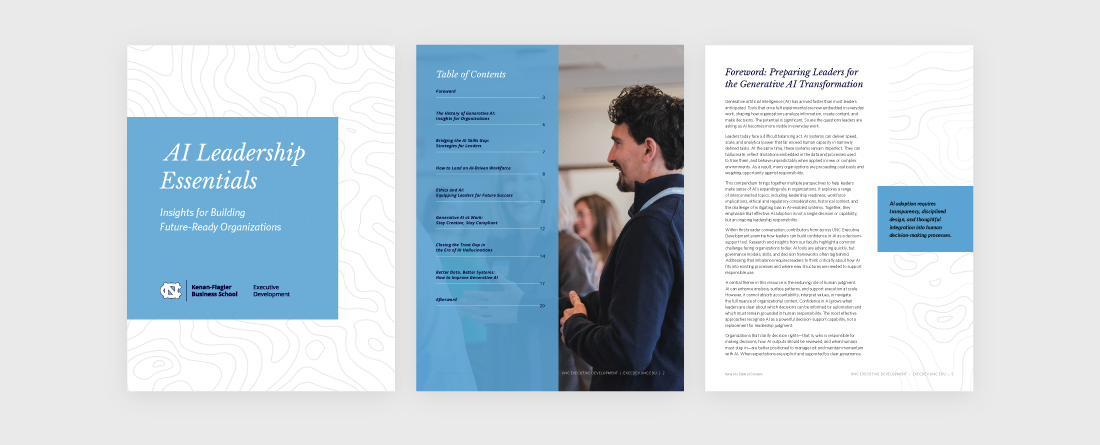
  • AI Leadership Essentials: Insights for Building Future‑Ready Organizations

    This downloadable whitepaper examines how workforce readiness, ethics, and human judgment must evolve alongside AI capabilities so organizations can unlock value without sacrificing accountability or credibility.

  • Why Metrics Matter for Succession Planning

    Learn why metrics matter for succession planning and leadership development. Data‑driven KPIs strengthen succession planning, develop high‑potential leaders, and ensure leadership continuity for long‑term success.

Contact Us About Your Organization's Needs

Pavilion with columns and red flowering bushes at UNC
Linkedin logo Facebook logo Instagram logo Email envelope icon